

Uttar Pradesh is rapidly emerging as a major centre for defence manufacturing in India. The state’s Defence Industrial Corridor (UPDIC) has attracted strong investor interest and is expected to receive investments worth ₹39,571 crore. The project has already moved from planning to execution, with nine manufacturing units currently operating and projects worth ₹13,486 crore already taking shape.
The corridor shows how UP is becoming an important part of India’s defence production network. Officials expect these ongoing projects to generate around 15,300 jobs, while the state plans to bring in even more investment over the next few years.
Six Cities Form the Backbone of the Project
The UP Defence Industrial Corridor was launched in 2018 and is being developed by the Uttar Pradesh Expressways Industrial Development Authority (UPEIDA). The corridor covers six major locations—Kanpur, Jhansi, Lucknow, Aligarh, Agra, and Chitrakoot.
The state acquired 2,095 hectares of land for the project. Out of this, authorities have already allotted 1,141.79 hectares to industries. So far, 65 companies have secured land to set up defence manufacturing units.
Kanpur has attracted the highest proposed investment of ₹12,948 crore, followed by Jhansi with ₹12,190 crore. Lucknow has received investment proposals worth ₹4,850.67 crore, while Aligarh has attracted ₹4,581 crore, Chitrakoot ₹4,392 crore, and Agra ₹607 crore.
Also Read: Omaxe Unveils ₹6,200 Crore Hospitality Expansion, Bets Big on Uttar Pradesh
More Investment and Jobs Planned
The Yogi government now aims to attract another ₹25,000 crore in investment over the next five years. Officials estimate that this fresh investment could create 20,000 to 22,000 additional jobs.
At present, the corridor has nine operational manufacturing units, with three each in Kanpur, Lucknow, and Aligarh. UPEIDA expects 14 more industrial units to begin production before the end of the current financial year in March 2027.
Companies Begin Production Across the Corridor
Several companies have already started manufacturing at their new facilities.
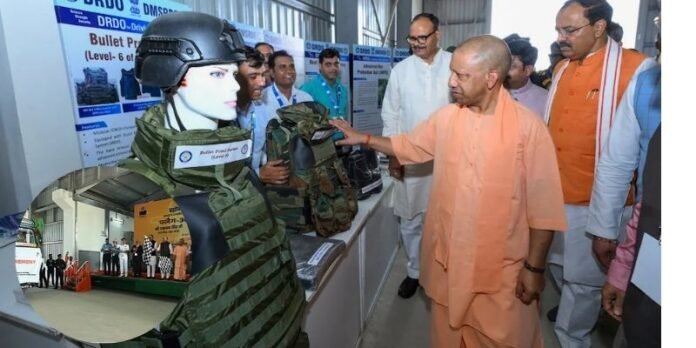
In Kanpur, Adani Defence and Aerospace has started work at its ₹1,500 crore ammunition factory, the biggest investment in the corridor so far. AR Polymers Private Limited has begun producing ballistic materials and protective gear after investing ₹48 crore. Modern Materials and Sciences Private Limited has also started manufacturing defence textiles with an investment of ₹38.58 crore.
Aligarh has also seen steady progress. Veriwin Defence Private Limited has started manufacturing small arms after investing ₹65 crore. Nitya Creations India Private Limited has begun producing precision weapon components with an investment of ₹12 crore. Shridha Udyog has invested ₹3.7 crore in manufacturing defence components. Meanwhile, AMITECH has launched its space port station with an investment of ₹330 crore.
Lucknow Emerges as a Defence and Aerospace Hub
Lucknow is developing into a major defence and aerospace manufacturing centre. Aeroloy Technologies has started titanium casting operations after investing ₹320 crore. BrahMos Aerospace has begun production and assembly of the BrahMos NG missile system at its ₹300 crore facility. Sankalp Safety Solutions has also started manufacturing safety equipment and woven protective materials with an investment of ₹14 crore.
A Major Push for UP’s Economy
Industry experts believe the Defence Industrial Corridor will play an important role in changing UP’s economy. The Indo-American Chamber of Commerce says the project will create a high-value manufacturing ecosystem, attract global investment, and strengthen the state’s industrial base.
For many years, UP was known mainly for agriculture and traditional industries. The growth of defence and aerospace manufacturing is now giving the state a new industrial identity.
CM Yogi has strongly supported the project. During a visit to Hamirpur on June 21, he described the Defence Industrial Corridor as a game changer for Bundelkhand and the state’s economy. He said the project is bringing large investments and new employment opportunities to regions that had remained behind in industrial development for decades.


