
For years, Indian politics revolved around welfare promises, caste equations, and coalition arithmetic. But in the last few years, Uttar Pradesh Chief Minister Yogi Adityanath has created a different political and governance model. This model combines development, strict law and order, and assertive Hindutva. Today, many BJP-ruled states openly follow parts of this model, while even opposition governments have started adopting some of its methods.
The “Yogi Model” has now become one of the biggest political discussions in the country because it mixes governance with strong political messaging.
Development as the Core of Governance
One of the strongest pillars of the Yogi Model is rapid development. Since 2017, UP has seen a major push in infrastructure and investment. The government focused heavily on roads, expressways, airports, logistics parks, and industrial corridors.
Projects like the Purvanchal Expressway, Bundelkhand Expressway, and Ganga Expressway changed the connectivity map of the state. New airports in Ayodhya, Kushinagar, and Jewar aim to turn UP into a major economic hub. Now, people know UP as a ‘Expressway Pradesh’ Metro projects expanded in cities like Lucknow, Kanpur, and Agra.
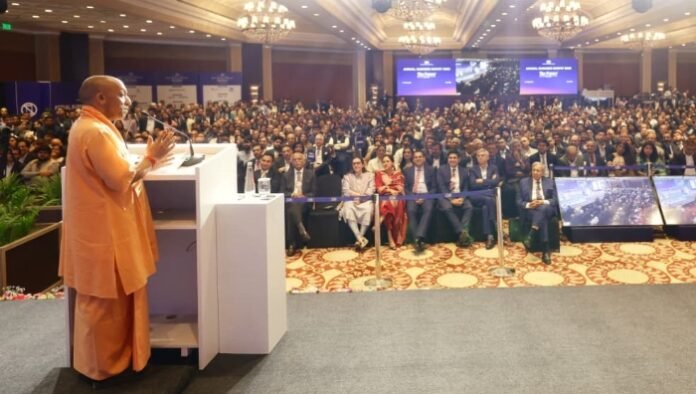
The Yogi government worked hard to bring investment by hosting Global Investors Summits to attract big companies to UP. They made it easier to do business by creating land banks, simplifying approvals, and offering single-window clearances.
The Yogi government also supported small businesses and local industries. The One District One Product (ODOP) scheme helped artisans and small traders promote products like Banarasi sarees, Moradabad brass work, and Bhadohi carpets. This support has given them branding and support for exports.
The government also pushed sectors like defence manufacturing, electronics, renewable energy, data centres, and semiconductors. BrahMos manufacturing unit in Lucknow is part of that development push. UP now presents itself not just as a political powerhouse but also as an emerging economic engine.
Strict Law and Order
The second pillar of the Yogi Model is tough law and order. Before 2017, UP carried an image of crime, mafia control, riots, and political protection for gangsters. The Yogi government changed this image through aggressive policing and strict administrative action.
Gangsters, mafias, and bahubalis faced continuous crackdowns. Police encounters against wanted criminals became one of the most discussed topics around the nation. The administration also seized illegal properties linked to criminal syndicates.
The bulldozer became a political symbol of CM Yogi’s governance. Authorities demolished illegal encroachments and properties linked to organised crime. People show it as strong action against criminal networks and illegal occupation.
The government also increased police visibility in public places. Anti-harassment squads, patrol units, CCTV expansion, and tighter monitoring improved the feeling of security in many cities. Women’s safety became an important political message of the administration.
This strict law-and-order approach created a perception that the government keeps unwanted and antisocial elements under control. Supporters argue that this environment helped investors gain confidence in UP.
Today, several states openly use similar “bulldozer action” and anti-mafia campaigns, showing how influential this model has become in Indian politics.
Hindutva and Cultural Revival
The third pillar of the Yogi Model is assertive Hindutva and cultural revival. Unlike many leaders who speak carefully on religious identity, Yogi Adityanath openly presents himself as both a Hindu monk and political leader, and has shown that a religious man can be a good administrator and follow Dharma.
The construction of the Ram Mandir in Ayodhya became the biggest symbol of this cultural movement. The government also developed religious circuits linked to Lord Ram and Lord Krishna. The Kashi Vishwanath Corridor transformed the spiritual image of Varanasi and increased religious tourism.
Religious tourism now plays a major role in UP’s economy. Cities like Ayodhya, Varanasi, Mathura, and Prayagraj attract millions of pilgrims and tourists every year. Massive spending on temples, ghats, roads, lighting, and public infrastructure compels people around the nation to come to UP.
The government also focused on reviving ancient Hindu sites and heritage locations. Sambhal recently entered political and media discussions after excavation work. Several ancient temple sites were recovered from Sambhal. People see such actions as an effort to reconnect India with its civilisational roots.
The Yogi Model presents Hindutva not only as politics but also as cultural identity, heritage revival, and tourism-led development.
A Political Model Beyond UP
The Yogi Model now influences politics far beyond UP. Many BJP leaders openly admire this governance style. Bulldozer action, anti-mafia campaigns, strong religious symbolism, and aggressive development politics now appear in several states.
This model combines four powerful political elements together – Hindutva, development, strong administration, and welfare delivery. That combination makes it difficult for opponents to counter politically.
For supporters, the Yogi Model shows decisive governance, visible development, cultural confidence, and fear-free administration. Whether one agrees with it or not, the model has clearly become one of the defining political models in modern Indian politics.


