
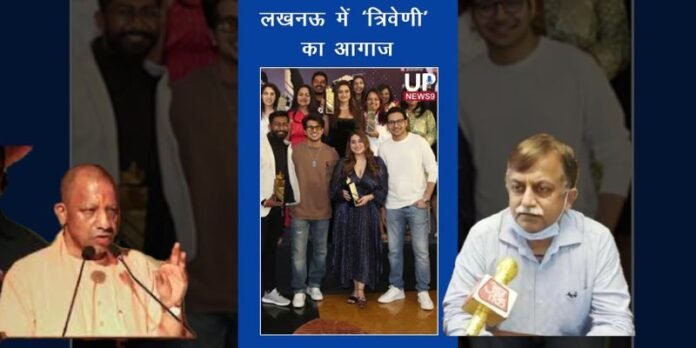
The second day of the three-day Digital Democracy Dialogue “Triveni” in Lucknow focused on Uttar Pradesh’s journey of governance, development, and economic growth. More than 100 digital creators, policymakers, industry leaders, and experts from different fields attended the event and discussed how the state has changed over the past nine years.
Speakers at the event underlined the Yogi Adityanath government’s development model and described how UP has moved from being labelled a backward state to becoming one of India’s fastest-growing economies.
Better Coordination Brought Faster Development
During a discussion session, CM Yogi Adityanath’s advisor Avanish Awasthi spoke about the government’s achievements since 2017. He said that before 2017, there was little coordination between the state and central governments, which often delayed the implementation of welfare schemes.
According to Awasthi, the situation changed after the Narendra Modi government came to power at the Centre in 2014 and the Yogi government took charge in UP in 2017. He said that this coordination helped ensure the effective implementation of major schemes such as PM Awas Yojana, Swachh Bharat Mission, and education-related programs.
Focus on Law and Order
Awasthi said that improving law and order was one of the government’s first priorities. He said that the administration adopted a zero-tolerance approach toward crime and made a strong police force through large-scale recruitment.
He also said the introduction of reservations for women in police recruitment and increased investment in modern policing and technology. According to him, CM Yogi personally reviews law-and-order issues on a daily basis.
Action Against Mafia and Land Encroachments
Speaking about anti-mafia operations, Awasthi said the government launched action against organised crime networks across the state. He added that authorities recovered illegally occupied government land and used some of it for housing projects aimed at the poor.
He also pointed to the strict implementation of the Gangsters Act and said these measures helped improve public confidence and create a safer environment for development.
Infrastructure and Investment Drive
Awasthi said UP has attracted major investments through business-friendly policies. He stressed projects such as the Defence Corridor and BrahMos missile manufacturing facilities as examples of the state’s industrial progress.
He also said that around 60% of India’s expressway network is now located in UP. Projects including the Purvanchal Expressway, Bundelkhand Expressway, and Ganga Expressway have significantly improved connectivity across the state.
Referring to the Noida International Airport at Jewar, he said the project remained delayed for years but moved forward rapidly under the current government. Commercial operations are expected to begin soon.
Industry Growth and Reduced Migration
Milind Kamble, founder-chairman of the Dalit Indian Chamber of Commerce and Industry (DICCI), said UP has emerged as a major growth engine for the country. He said that investors now view the state differently because of improvements in infrastructure, law and order, and ease of doing business.
He also praised the One District One Product (ODOP) initiative, saying it has encouraged entrepreneurship and created new opportunities for local communities.
Rising Income and Economic Ambitions
Alka Bahuguna Dhoundiyal, Director of Economics and Statistics, said UP is increasingly gaining attention at theglobal level. She noted that the government is closely monitoring development indicators as it works toward its goal of becoming a one-trillion-dollar economy.
MLC Saket Mishra said migration from the state has reduced as employment and educational opportunities have improved. He said that better governance, support for farmers, and stronger law and order have contributed to the state’s overall progress.
The discussions concluded with speakers emphasising that the Yogi development model is now being closely watched across the country as the state continues its push toward economic growth and modernisation.


