
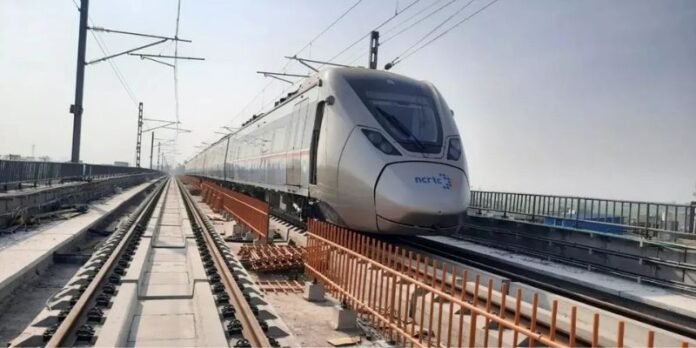
The State Capital Region (SCR) development plan in UP is now moving ahead at a fast pace. The project follows the model of the National Capital Region (NCR). Under this plan, the government will build a modern High-Speed Regional Rapid Transit System (RRTS), also known as the Namo Bharat Corridor.
The corridor will directly connect Kanpur, Unnao, Lucknow and Ayodhya. Once the project is complete, passengers will be able to travel from Kanpur to Ayodhya in just 90 minutes.
187-Kilometre High-Speed Corridor
The proposed Namo Bharat Corridor will cover around 187 kilometres. The route will begin from Nayaganj in Kanpur and pass through Unnao, Lucknow and Raebareli before reaching Ayodhya.
The project will be completed in two phases. In the first phase, construction will take place from Nayaganj to Amausi, covering nearly 67 kilometres. The second phase will extend the corridor up to Ayodhya.
Officials estimate the total project cost at around Rs 32,000 crore.
12 Stations and 6 Major Hubs Planned
The corridor will have 12 stations along the route. In addition, authorities will develop six major station hubs to support economic and urban growth.
- Juggour will become an institutional district.
- Sushant Golf City will develop as a premium residential zone.
- Nayaganj and Banthra will serve as logistics hubs.
- Amausi will be developed as an aero hub.
- Nawabganj and Ayodhya will emerge as tourism hubs.
- Safdarganj will focus on agriculture-based industries.
Also Read: UP Emerges as a Strong Hub for Next-Generation Business Leaders Under Yogi Government
Boost for Jobs, Business and Tourism
The high-speed corridor will do more than reduce travel time. It will also support business activities, industries, tourism and employment across the region.
Millions of people will benefit from faster daily travel for work, education and trade. At the same time, Lucknow will grow as a major regional interchange hub.
Proposal Presented in LDA Meeting
AECOM agency presented the proposal during a meeting held at the Lucknow Development Authority (LDA) on May 14. LDA Vice Chairman Prathamesh Kumar chaired the meeting.
Officials also discussed multi-modal connectivity and development around the station areas. According to planners, the project could significantly improve connectivity and economic growth in central Uttar Pradesh.


.)