
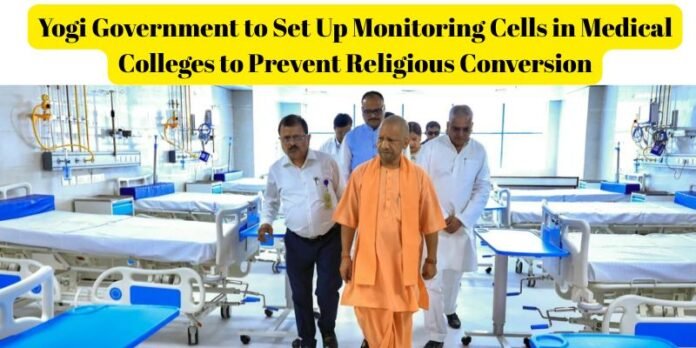
The Yogi government plans to create special monitoring cells in medical colleges to stop religious conversion activities and cases linked to “Love Jihad.” The decision comes after recent cases surfaced in major medical institutions such as KGMU and SGPGI in Lucknow.
Earlier, the Yogi Adityanath government introduced the Uttar Pradesh Prohibition of Unlawful Religious Conversion (Amendment) Act to prevent forced religious conversions and Love Jihad. The law provides punishment ranging from 20 years in prison to life imprisonment in serious cases.
Governor Anandiben Patel has now directed medical institutions to establish special monitoring cells. Dr Sudhir M. Bobde, Officer on Special Duty to the Chancellor, sent instructions to universities and asked them to take necessary steps.
What is the Religious Conversion Prevention Monitoring Cell?
The law has been brought because of reports of several Love Jihad and religious conversion cases at KGMU and SGPGI. A young woman from SGPGI went missing, raising concerns within the institution.
After these developments, all medical and dental colleges affiliated with Atal Bihari Vajpayee Medical University asked to establish monitoring cells. These cells will focus on preventing religious conversion-related activities and maintaining a safe academic environment.
Also Read: Conversion Allegations Surface in Lucknow PGI; Irshad Ali Accused of Abducting Young Hindu Woman
How Will the Cell Function?
The monitoring cell will carry out several responsibilities:
- It will create awareness among students, doctors, and staff regarding religious conversion-related issues.
- It will closely monitor suspicious activities inside institutions.
- It will educate students and employees about their rights, responsibilities, and applicable rules.
- It will organize awareness campaigns from time to time.
- It will ensure that authorities do not suppress complaints and instead investigate them properly.
- It will help maintain a healthy and secure atmosphere within educational institutions.
University authorities have directed all colleges to form these cells quickly and inform the university administration about their establishment.
Concerns Over Conversion Networks in Medical Institutions
Investigation says, religious conversion groups operate inside hostels and medical college campuses. These groups target junior students, doctors, nursing students, and staff members.
Authorities believe the new monitoring cells will help control such activities and strengthen security and vigilance across institutions.
SGPGI Love Jihad Case
A major case surfaced at SGPGI in Lucknow. A 21-year-old woman from a Hindu family living on the SGPGI campus went missing on May 26, 2026.
Her family accused Irshad Ali, who was known to the family, of trying to convert her and send her to Syria. According to the family, he gained their trust through friendship and later developed a close relationship with the woman.
The family also alleged that Irshad spoke about taking her to Syria. They claimed he received support from Dr Ajmal, a doctor associated with SGPGI. Reports state that Dr Ajmal helped build a mosque on the SGPGI campus and another one in Pahalgam. Authorities have currently restricted his foreign travel.
The incident raised questions about alleged attempts to convert young women and send them to Islamic countries such as Syria.
KGMU Religious Conversion Case
Another case emerged at King George’s Medical University (KGMU) in Lucknow.
According to the people, Dr Ramizuddin trapped a Hindu woman doctor in a relationship, exploited her, and pressured her to convert to Islam. Reports state that he was already married and had converted another Hindu woman before marrying her through Nikah.
The woman doctor learned details of the case from Ramizuddin’s wife. As the matter unfolded, investigators claimed they uncovered a wider network and political connections linked to religious conversion activities.
Reports further alleged that Ramizuddin’s father, Salimuddin, had married four Hindu women after forcing them to accept Islam.
Agra Medical College Conversion Allegations
Dr Ramizuddin completed his MBBS studies at Agra Medical College. Reports claim that in 2012, he helped create an organization called Islamic Medicos Meet.
According to these allegations, clerics attending the group’s meetings advised students on how to develop relationships with Hindu women, encourage religious conversion, and later marry them.
The group also reportedly operated a WhatsApp network. Reports claim several doctors participated in these activities. Allegations further state that Ramizuddin used marijuana imported from the United States and promoted it as a way to increase sexual power.
When Ramizuddin later joined KGMU, reports claimed that several doctors there maintained links with controversial Islamic preacher Zakir Naik. According to these accounts, their influence grew significantly during the early 2000s.
Religious Conversion Activities Over the Years
Reports suggest that similar methods of targeting Hindu women appeared both at KGMU and Agra Medical College.
It remains unclear whether the groups in the two institutions worked together or separately. However, reports claim that clerics gradually became regular visitors to several medical colleges.
At Basti Medical College, clerics started visiting the campus over the past year. At Bulandshahr Medical College, a first-year HOD used Hadith references while teaching medical science. Colleagues later intervened and stopped the practice.
Reports also state that some students pressured the college administration to arrange facilities for Namaz. However, opposition from others prevented this proposal from moving forward.
Links to a Delhi Blast Accused
Investigators also found links between Dr Ramizuddin and Dr Parvez Ansari, who was arrested in connection with the Red Fort bomb blast case in Delhi.
According to reports, they built a network aimed at converting female students at SN Medical College. Both reportedly lived in the same hostel and worked together to target Hindu women.
The network watched female students closely, from classrooms to libraries. Reports says members later recorded objectionable videos and used them to pressure women into converting to Islam. Several women and students became victims of this conspiracy.
Strict Legal Provisions in UP
To curb forced religious conversions and Love Jihad, the UP government tightened the Uttar Pradesh Prohibition of Unlawful Religious Conversion (Amendment) Act.
The law provides:
- Three to ten years of imprisonment and heavy fines for conversions through fraud, deception, or inducement.
- Seven to fourteen years of imprisonment and fines up to ₹10 lakh for foreign-funded or large-scale illegal conversions.
- Twenty years to life imprisonment for cases involving marriage fraud, blackmail, or forced religious conversion.
The amended law also allows any affected person or anyone with information about illegal conversion activities to file an FIR. The government has also imposed stricter conditions for granting bail in such cases.


