

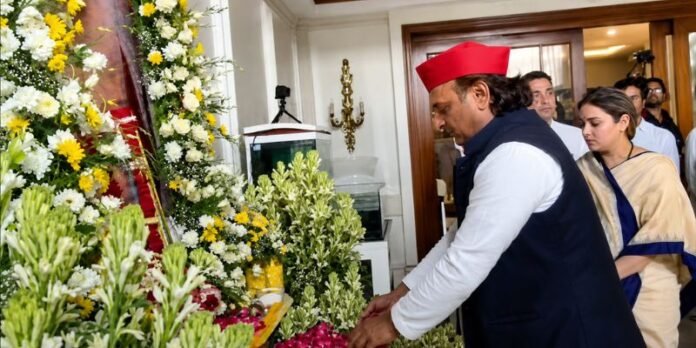
Today (May 25), Samajwadi Party Chief Akhilesh Yadav joined the ‘tehravi’ ceremony of his late stepbrother Prateek Yadav, showing that he only went there just to show the public that he cares for Prateek Yadav just associated with the family. But not the part of the family. He did not even save his head, which is a must for a Hindu family member to do after a member of the family dies.
Prateek Yadav, son of Samajwadi Party founder Mulayam Singh Yadav, passed away recently. During the thirteenth-dayritual, many known faces from UP reached the family home to offer condolences.
CM Yogi Paid Tribute to Prateek Yadav
Today, CM Yogi also visited and paid tribute to the grieving family. After him, Samajwadi Party chief Akhilesh Yadav arrived, offered flowers to Prateek’s photograph, and met several leaders present there. Reports also suggested that he did not interact much with Aparna Yadav during the visit.
Nobody can question a person for attending the final rituals of a family member. That is basic humanity. But politics does not exist in isolation from public memory. People remember relationships, and they also remember distance. And in Akhilesh Yadav’s case, many people have often seen a visible political and personal distance between him and Prateek Yadav’s side of the family.
During his visit, it became clear that Akhilesh Yadav was never close to Prateek publicly. He did not save his head on Prateek’s thirteenth-day ritual. However, He followed that ritual during late Mulayam Singh Yadav’s death.
There were absence of emotional warmth during his visit and it looked like it was more to send a message that he cares for his family, but the public has seen his actions from the day of Prateek’s death.
While writing a condolence post on Twitter, he failed to mention Prateek as his brother and on the 13th day, he failed to do the head-saving rituals.
Faith Cannot Be Only Political Messaging
In recent months, Akhilesh Yadav has tried to project himself as someone connected to Hindu identity and traditions. He talks about temples, festivals, and Sanatan values when politics demands it. He wants voters to see him as rooted in Hindu culture. But when it came to showing these, he failed to do basic Hindu rituals during his own family member’s last rituals.
In India, people can’t force you to follow religion or rituals, but when you are a public political figure who talks about these traditions and fails to follow, people notice. This shows duality in Akhilesh’s action. Politics and family often mix in India. Leaders know that every public appearance sends a message, but some moments should remain above politics.


