

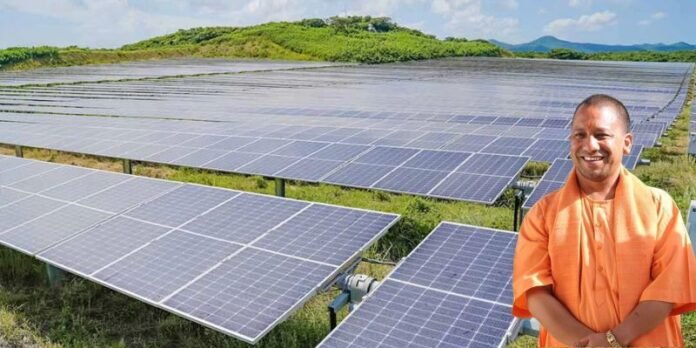
The mornings in Kabrai town of Mahoba district now look very different. Before sunrise, long rows of solar panels begin to shine across the dry landscape. A few years ago, this region was known for water scarcity, barren land and migration. Today, the same land is producing electricity and changing the identity of Bundelkhand.
On May 22, a 220 KV substation built under the Green Energy Corridor-2 project sent 70 megawatts of solar power to the state grid for the first time. Officials see this as a major milestone for Bundelkhand’s energy future. The project shows how the region is becoming an important part of Uttar Pradesh’s clean energy strategy.
Extreme Heat Is Helping Solar Power Production
Bundelkhand is currently facing intense heat, with temperatures crossing 46 degrees Celsius. For ordinary people, the weather has become difficult. But for the solar energy sector, the long and harsh summer has created new opportunities.
Because of longer sunlight hours, solar power generation in the region increased by nearly 20% in May. During summer, the sun rises early and sets late, allowing solar plants to produce electricity for a longer time every day.
In winter, many solar plants begin production after 7 am. In summer, panels start generating power as early as 5:30 am. This increase in sunlight hours has boosted total electricity generation across Bundelkhand.
Experts say solar panels work best between 25 and 35 degrees Celsius. Very high temperatures can reduce their efficiency because the panels use silicon-based semiconductor technology. When temperatures cross 40 degrees, production efficiency starts falling. Even then, the longer duration of sunlight helps maintain high overall output.
Saurabh Singh, an engineer working at a private solar plant in Jalaun, says power generation can rise by up to 30% if afternoon temperatures remain below 40 degrees. Despite the heat-related challenges, solar production continues to grow because of extended daylight hours.
Kabrai Model Becomes a Symbol of Change
Kabrai has now become one of the strongest examples of Bundelkhand’s solar transformation. The newly developed substation in the town has successfully started transmitting 70 megawatts of electricity from a private solar plant.
The Uttar Pradesh Power Transmission Corporation Limited (UPPTCL) is building a strong transmission network across Bundelkhand to support future solar projects. The corporation plans to develop 21 substations at a cost of Rs 5,400 crore to handle electricity from nearly 4,000 megawatts of solar capacity. Ten substations have already become operational.
New substations in Charkhari, Dakor, Bangra, Bamour, Birdha, Jaitpur, Hamirpur, Banda and Madawara are expectedto start soon. Officials believe this network will strengthen power transmission in the entire region and support large-scale renewable energy projects.
Barren Land Is Turning Into a Source of Income
The solar boom has also started changing the rural economy of Bundelkhand. Farmers who once struggled to earn from dry and unproductive land are now receiving stable income through land lease agreements with solar companies.
In Panwari area of Mahoba district, farmer Avadhesh Pratap Singh leased his 30-acre land to a solar company. Earlier, he cultivated wheat and gram. Farming required heavy spending on seeds, labour and fertilisers, while wild animals often damaged crops. Even after months of hard work, earnings remained uncertain.
Now a 15-megawatt solar plant stands on his land. Under a 29-year and 11-month agreement, he receives Rs 50,000 per acre every year. The rent also increases by 3% annually. Without farming, his yearly income has reached nearly Rs 15 lakh.
Many farmers in villages like Garaura and Kanakua have also adopted the same model. For many families, barren land has become a steady source of income instead of a burden.
However, some farmers have raised concerns over delayed payments. In parts of Chitrakoot, farmers say companies sometimes release money in installments and fail to pay on time. District-level committees have been formed to resolve such disputes.
Jalaun Is Emerging as a Solar Capital
Among all districts in Bundelkhand, Jalaun is witnessing the fastest solar expansion. Over the last five years, projects with more than 300 megawatts of capacity have started there. These projects have attracted investments worth nearly Rs 1,500 crore.
The district administration has created a land bank of around 23,000 acres by identifying barren and unused land for solar projects. Officials believe this land can support nearly 4,000 megawatts of electricity generation in the coming years.
Companies such as BSUL, Coal India and NLC have already received land for projects worth 2,350 megawatts. Authorities estimate that total investment in Jalaun may reach Rs 16,000 crore in the future.
The projects are also creating local jobs. Road construction, transmission lines, substations and plant installation work have provided employment to many local workers. Officials hope this will reduce migration from the region.
Solar Projects Are Changing the Local Economy
The impact of solar projects is no longer limited to electricity production. The projects are bringing investment, infrastructure and employment to areas that remained neglected for decades.
Roads, substations and transmission lines are improving connectivity in remote villages. Land once considered useless is now attracting major private investment. The state government is also offering incentives such as exemption in stamp duty and electricity charges to encourage companies to invest in renewable energy.
The Uttar Pradesh government has set a target of developing 14,000 megawatts of solar park capacity by 2026-27. It also plans to add 4,500 megawatts of residential rooftop solar capacity and 1,500 megawatts through government and commercial rooftop projects.
Under the PM Kusum scheme, the state also plans to install solar pumps with a capacity of 2,000 megawatts. UP currently produces around 2,876 megawatts of solar power, while projects worth another 4,816 megawatts are expectedto begin soon. Bundelkhand holds the biggest share in this expansion.
Challenges Still Remain
Despite rapid growth, several challenges continue to affect the solar sector in Bundelkhand. Land acquisition disputes, delayed payments to farmers, transmission capacity issues and reduced efficiency during extreme heat remain major concerns.
Experts believe the region now needs investment in battery storage and smart grid systems. These technologies can help store electricity generated during the day and improve overall power management.
Even with these challenges, Bundelkhand’s transformation has become clearly visible. The region, once known mainly for drought and poverty, is now emerging as one of North India’s biggest renewable energy centres. The same scorching land that once forced people to migrate is now producing electricity, attracting investment and creating new opportunities for thousands of families.


