
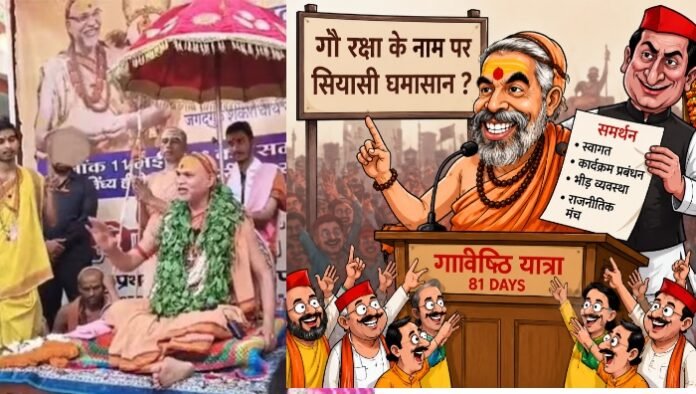
The ‘Gavishti Yatra’ led by Swami Avimukteshwaranand has increasingly shifted from a purely religious campaign to a political movement. On Wednesday (May 20), The 81-day journey, planned across 403 Assembly constituencies of UP, entered its 18th day. It has already covered more than 90 Assembly segments in eastern UP. However, as the yatra progresses, political discussions around its intent continue to intensify.
The biggest question dominating political circles remains clear: if cow protection stands at the centre of the campaign, why did Swami Avimukteshwaranand choose UP as the primary destination after Bihar?
States such as West Bengal, Kerala, and Tamil Nadu witnessed more danger to cows and a ground for cow slaughter in recent years. Yet, the yatra never expanded aggressively into those regions. Instead, the campaign moved directly toward UP, a state that already enforces one of the strictest anti-cow slaughter laws in the country.
It is believed the answer connects directly with the Bihar Assembly elections and the political experiment that grew there.
Bihar Model and Its UP Expansion
During the Bihar Assembly elections, Swami Avimukteshwaranand openly tried electoral intervention through the ‘Gau Matdata Sankalp Yatra’ and the self-declared ‘gau-bhakt candidate’ model.
He claimed support for candidates across all 243 Assembly constituencies. Eventually, nearly 198 independent candidates with his backing contested the elections.
The outcome, however, failed to deliver political success. The candidates collectively secured around five to six lakh votes, but none won a seat.
Most candidates also lost their deposits. Despite the electoral setback, political observers now see a similar pattern reappearing in UP under a different narrative and larger scale.
The timing and geographical focus of the Gavishti Yatra, therefore, raise questions about whether the movement aims at religious awakening alone or whether it seeks to create a fresh ideological and political battle in UP ahead of future electoral battles.
Why UP Became the Focus
The political importance of UP makes the choice particularly meaningful. Unlike several opposition-ruled states where cow slaughter and beef politics frequently trigger controversy, UP already operates under an aggressive law on cow protection.
Under the leadership of CM Yogi, the state government introduced one of India’s toughest anti-cow slaughter law in 2020. The administration used laws such as the NSA and Gangster Act against accused offenders.
Authorities also launched property seizure drives, established thousands of cow shelters, promoted direct benefit transfers for cattle owners, and linked cow-based rural economics with natural farming initiatives.
Because of these measures, people now ask what new agenda Swami Avimukteshwaranand seeks to introduce in a state where cow protection already forms a central pillar of governance and Hindutva politics.
Ideological Competition with the Yogi Model
The emerging debate has become more politically sensitive because UP already hosts one of the country’s strongest Hindutva leadership structures. Yogi Adityanath not only serves as CM but also represents the Gorakshpeeth tradition and remains one of the most influential faces of Hindutva politics and cow protection.
Against this backdrop, speeches delivered during the Gavishti Yatra have attracted considerable attention. At several public meetings, Swami Avimukteshwaranand indirectly targeted the CM and commented on ideological superiority within the broader Sanatan framework. One statement in particular drew political attention when he said, “Only one among us is the true Sanatani Hindu.”
People interpret such comments as signs of ideological competition rather than purely religious mobilization. As a result, discussions around the yatra increasingly focus on political positioning instead of religious awareness.
Limited Public Response on the Ground
Despite extensive publicity and ambitious planning, the yatra has not generated the kind of mass wave that supporters initially expected. Reports from multiple districts indicate limited crowd participation and stronger dependence on local political networks.
Leaders associated with the SP and Congress, especially second and third-rung regional figures, appeared at several events linked to the yatra. People believe many local leaders view the campaign as an opportunity to build future political equations and support their importance in constituency-level politics.
This trend is similar to Bihar, where many local actors attempted to use the cow protection platform for electoral gain rather than ideological commitment alone.
Media Confrontations Added to the Controversy
Another factor that intensified scrutiny around the yatra involves repeated confrontations with journalists. Local media personnel claim that whenever reporters asked for evidence regarding allegations connected to cow slaughter, beef smuggling, or alleged government protection, Swami Avimukteshwaranand often reacted sharply instead of directly answering the questions.
These exchanges have contributed to a growing perception among sections of the media that the campaign’s allegations lack sufficient factual backing. People argue that strong rhetoric without documented evidence weakens the credibility of the movement and shifts focus toward political theatrics.
The Core Question Behind the Yatra
The larger political question now revolves around intent. Does the Gavishti Yatra genuinely represent a religious awareness campaign centered on cow protection, or does it represent another political experiment modelled after Bihar?
The answer may determine how seriously voters engage with the movement in the coming months.
At present, the situation at ground suggest that voters in UP continue to prioritise administrative performance, governance credibility, and established leadership over emotionally charged slogans alone. In a state where Hindutva politics already occupies a dominant position under CM Yogi, creating a parallel ideological space may prove more difficult than thought.


