

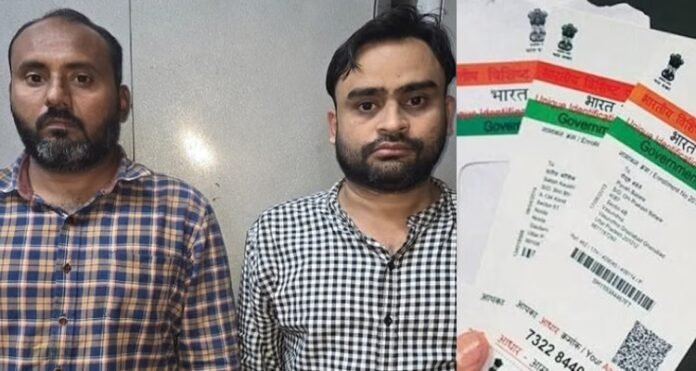
The STF in Aligarh has busted a gang from the Jivangarh area of Quarsi that was hacking government portals to forge Aadhaar cards. Investigation has revealed signs that this network produced Aadhaar cards not only for Indian citizens but also for Rohingya — illegal migrants. Moreover, the gang’s activities appear to have originated from the West Bengal border and involved hacking government sites in multiple states to carry out the fraud. Four recovered laptops are currently undergoing forensic examination at the cyber lab so that three years’ worth of data can be scrutinised.
Sajid Hussain and Naimuddin sent to jail
The STF’s Lucknow unit raided public service centers in Jivangarh, lane number 12, in the early hours of Thursday and arrested operators Sajid Hussain and Naimuddin. FIRs have been lodged against them and three absconding accused including their boss; the arrested men have been sent to jail. Quarsi police are now conducting the investigation, and the first step will be a forensic examination of the four seized laptops. According to senior STF officers, the arrested Sajid previously worked at a company that used to make Aadhaar cards.
Network linked to West Bengal, web spread across many districts
Sajid initially connected with individuals involved in similar Aadhaar fraud operations along the West Bengal border. Subsequently, through these contacts — and through Prashant, an employee of an Aadhaar service company in Gujarat — Sajid established contact with Akash in Delhi. Once Akash assigned him the task, Sajid systematically expandedhis network over the next three years across Aligarh and several western Uttar Pradesh districts such as Hathras, Bulandshahr, Meerut, Kasganj, Etah, Badaun, Sambhal, Amroha, Moradabad and Rampur — all regions with sizeable Muslim populations.
The forensic report will confirm details
Investigators have not ruled out that Sajid and his associates, aided by the Delhi-based hacker, prepared Aadhaar cards for Rohingya and other illegal migrants. This input prompted the STF to launch the entire probe. Forensic teams are now examining the laptops and other systems to identify whose names were used to create Aadhaar cards, what data the gang altered, and from whom they collected money. The process is already underway.
— Mrigank Shekhar Pathak, SP City
Cyber experts assisting with IP tracking
Teams are active to arrest Akash, Amit and Sharad. The cyber team is tracing the IPs of the portals and systems they operated. Once they are caught, a clear picture of the whole network will emerge.
— Sarvam Singh, CO Third
The target was 50 Aadhaar cards a day
Sources say the master hacker in Delhi had set Sajid a daily target of at least 30 and up to 50 Aadhaar cards. To achieve this, Sajid used his network to recruit customers in Aligarh and neighbouring districts.
Clues from CDRs and location data
A key question is how many states the Delhi mastermind Akash had spread his network into. Police and STF teams are searching for Akash as well as for Aligarh-based absconders Sharad and Amit. The arrested suspects’ phone CDRs are being examined to trace their locations.
Investigation found that Akash had hacked sites of the Department of Women and Child Welfare in Uttarakhand and Jharkhand that were linked to Aadhaar usage and had allowed their use. It is suspected that sites in West Bengal, Gujarat and other states were also hacked. Amit and Sharad originally made Aadhaar cards themselves; later they linked up with Sajid through Akash.
How the fake Aadhaars were prepared
To get an Aadhaar card one normally needs a birth or domicile certificate. The gang hacked government sites and inserted arbitrary names, addresses and identities to fabricate fake birth/domicile certificates. They even possessed authorised signatures and stamps from councillors, schools, hospitals and others. Using those certificates as proof, they got Aadhaar cards made.

