
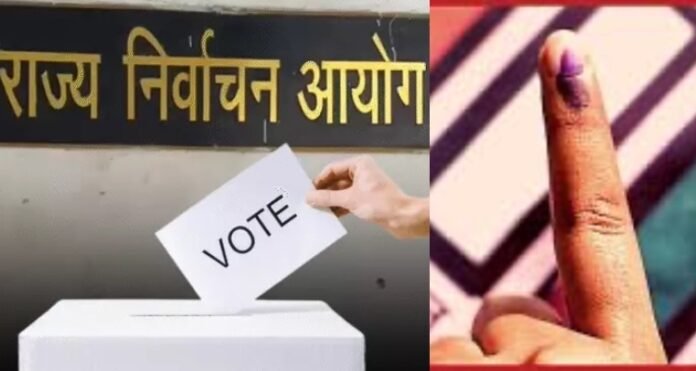
In preparation for the 2026 Panchayat elections in Uttar Pradesh, the State Election Commission is facing its most serious and complex challenge — removing nearly one crore duplicate voters from the electoral rolls. Despite identifying a large number of fake and duplicate voters through Artificial Intelligence (AI), district-level and sub-district officials are not showing the required seriousness towards the task. As a result, it appears difficult to purify the voter list on time.
AI detected over one crore duplicate voters
Using AI-based analysis, the State Election Commission has identified voters whose names appear at more than one place in the Panchayat voter list. The primary reason for this issue is believed to be the recent expansion of municipal limits and the formation of new Nagar Panchayats. Several villages included in the newly expanded urban areas have voters whose names appear in both municipal and Panchayat voter lists. This has led to duplicate voter registrations, casting doubt on the integrity of the electoral process.
District officials not showing interest; Commission displeased
The election body had already provided district officials with lists of duplicate voters and instructed them to remove such names after physical verification. However, reports received by the Commission indicate that District Magistrates (DMs) and Sub-Divisional Magistrates (SDMs) are not taking this sensitive task seriously. Booth Level Officers (BLOs) are also reluctant, as the process requires door-to-door verification. Observing slow progress, State Election Commissioner Raj Pratap Singh will now hold a special video conference with all DMs to issue strict directives.
Debate continues over the election of Block Chiefs and Zila Panchayat heads
The State Election Commission has clarified that in the upcoming Panchayat elections, Block Pramukhs and Zila Panchayat Chairpersons will be elected indirectly by members, as per the existing system. According to Additional Commissioner Akhilesh Mishra, direct elections for these posts would require a constitutional amendment, which is currently not feasible. His statement came in response to Minister Om Prakash Rajbhar’s demand for direct elections, for which he claimed to have discussed the matter with the Chief Minister and the Central Government.
Revision schedule altered due to slow progress
The slow pace of removing duplicate voters has impacted the revision schedule of the voter list. The Commission initially issued the program on July 18, according to which the draft voter list was to be prepared between October 7 and November 24. Due to delays, the timeline was revised to October 14 – November 24. If progress remains slow, the Commission may have to issue another revised schedule. Officials admit that publishing the final electoral roll by January 15, 2026, may be difficult.
Physical verification mandatory — increased workload for BLOs
According to the Commission, duplicate voter names identified through computer analysis can only be removed after physical verification. BLOs must confirm whether a voter’s name is genuinely registered at multiple locations. Removal without physical checks is not permitted, making the process both time-consuming and labour-intensive.
Key voter list revision timeline
- Draft list preparation: October 14 – November 24 2025
- Draft publication: December 5 2025
- Claims & objections: 6 – 12 December 2025
- Final voter list publication: January 15 2026
Overall, the process of finalising an error-free voter roll before the 2026 Panchayat elections is becoming increasingly challenging due to administrative apathy and the requirement for ground-level verification. Though the Commission has used AI to identify the issue, the transparency and credibility of the democratic process will ultimately depend on how efficiently on-ground staff carry out the verification and correction work.

