

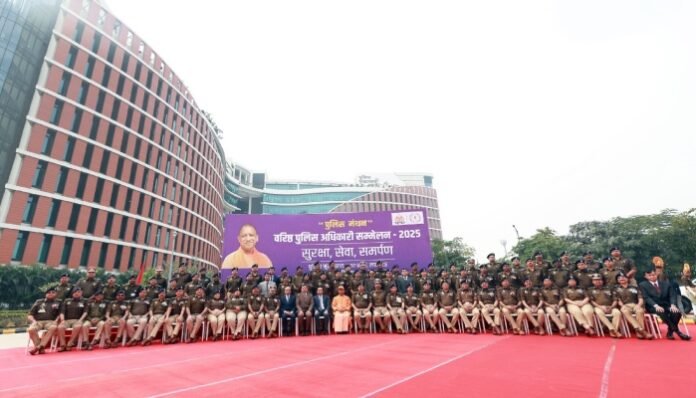
On the second day of the Police Manthan – Senior Police Officers’ Conference 2025, CM Yogi gave clear instructions to strengthen law and order in UP during the closing session on Sunday. In particular, he directed senior police officers to maintain strict monitoring over social media and cybercrime.
He emphasised a zero-tolerance policy against those who use social media to disturb law and order or harm social, caste, and religious harmony. Moreover, he instructed officials to strengthen border security and counter-terrorism mechanisms with modern technology to stop terrorism and drug trafficking originating from Pakistan, Bangladesh, and Nepal. Along with this, he ordered strict action against organised gangs involved in cow smuggling and religious conversion.
Strict monitoring of social media and cybercrime
CM expressed serious concern over the misuse of social media, misinformation, deepfakes, the dark web, cybercrime, and terrorist networks. Therefore, he instructed the police and intelligence agencies to take immediate notice of any objectionable content on social media that could disrupt law and order or social harmony. He also stressed that quick and strict legal action must be ensured in such cases.
Furthermore, he made it clear that no leniency should be shown towards elements trying to divide society on the basis of caste or religion, pressure the police, or create chaos. Hence, fake accounts, provocative posts, and organised propaganda campaigns must be identified and dealt with strictly under the law. He also pointed out that some anti-social elements are misusing the names of great leaders to form new organisations and spread unrest. As a result, police were instructed to thoroughly investigate such groups, dismantle their networks, and take strong legal action.
Special alert on religious conversion
CM Yogi described religious conversion as a serious challenge and said incidents like the one in Balrampur indicate that such activities are being carried out in an organised manner. Therefore, he directed the police and intelligence agencies to maintain continuous surveillance over conversion-related activities. In addition, social media-based intelligence must be strengthened so that such incidents can be stopped effectively at an early stage.
While appreciating the work done by the police so far, he said that intelligence gathering, local inputs, and technical surveillance need to be further strengthened. Thus, he stressed that close monitoring of all social media activity and timely action are essential to maintain peace, harmony, and law and order in the state.
Strengthening border security and counter-terror systems
The Chief Minister reviewed new dimensions of terrorist activities emerging from international borders with Pakistan, Bangladesh, and Nepal. Accordingly, he emphasised further strengthening border surveillance systems. He also instructed officials to enhance the use of artificial intelligence, financial tracking, technical analysis, and modern tools to curb so-called internationally funded religious conversion rackets.
Continuous action against drug trafficking and organised crime
Yogi Adityanath praised the police for their strict action so far against terrorism, drug trafficking, and organised crime. However, he said that these efforts must become even more decisive and effective. Therefore, he directed departments and security agencies to improve coordination, share real-time information, and take swift action to break the morale of criminal networks.
Strategy to target cow smuggling networks
The Chief Minister clearly stated that in cow smuggling cases, quick arrests alone are not enough. Instead, the entire network and its masterminds must be identified and punished with the strictest action. As a result, this would send a strong message against organised crime and help effectively curb cow smuggling and related offences. He also appreciated the police action taken in such cases.
Presentations during the second day of Police Manthan
On the second day of the Police Manthan program, several sessions were held. Session 8 focused on disaster management, civil defence, and home guards. Meanwhile, Session 9 dealt with large crowd management. Session 10 covered intelligence systems and emerging challenges such as social media, NGOs, and the Nepal border. Finally, Session 11 discussed anti-terrorism, narcotics, cow smuggling, and other organised crimes.

