

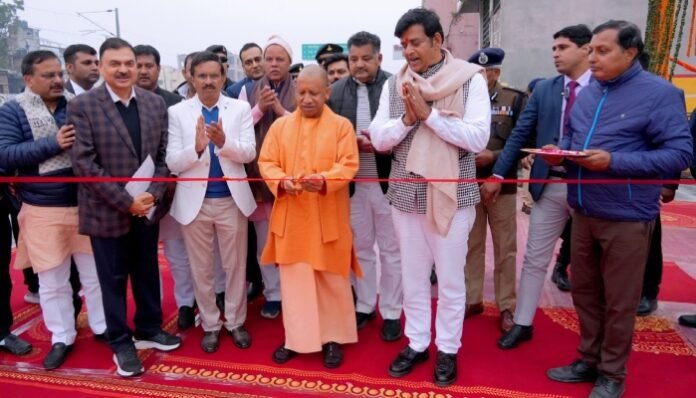
UP CM Yogi on Friday (December 19) inaugurated a new rail overbridge in Gorakhpur, built at a cost of ₹138 crore. Speaking at the event, he accused previous state governments of misusing public money for personal gain. In contrast, he said the present BJP-led government is using funds for development across the state.
As a result, the newly built Gorakhnath overbridge will ease daily traffic for more than one lakh people living in the area. Moreover, it will make travel smoother for devotees visiting the Gorakhnath Temple and tourists heading towards Nepal. Consequently, residents will finally get relief from frequent traffic jams.
Improved Connectivity and Better Urban Planning
According to officials, traffic load had increased on the existing route. Therefore, on CM’s instructions, a parallel overbridge was constructed. The new two-lane bridge is over 600 metres long and 7.5 metres wide. In addition, view cutters have been installed on both sides to protect residents’ privacy and reduce noise from vehicles.
Meanwhile, Yogi Adityanath recalled that eight years ago, Gorakhpur struggled with poor sanitation, disease, power shortages, and mafia influence. However, he said the situation has changed significantly. Roads have been widened, traffic systems improved, and connectivity with cities like Lucknow and Varanasi strengthened.
Government Highlights Development and Welfare Push
CM also spoke about broader development in eastern Uttar Pradesh. For instance, he mentioned the revival of the fertiliser plant and the development of Ramgarh Tal as a major tourist destination. As a result, the area’s old image of neglect and crime has faded. He further noted that several districts in the region now have medical colleges.
At the same time, he highlighted welfare schemes such as free ration, healthcare, LPG connections, and electricity for all. According to him, these benefits are being delivered without discrimination.
Targeting past regimes again, Yogi said earlier governments drained the state’s treasury due to corruption. Now, he claimed, that money is being redirected towards roads, education, and quality institutions. Therefore, he concluded, the impact of the “double-engine government” is clearly visible on the ground.

