

Uttar Pradesh has revealed a strong roadmap to enter India’s fast-growing semiconductor ecosystem. It has signalled a shift from intent to execution.
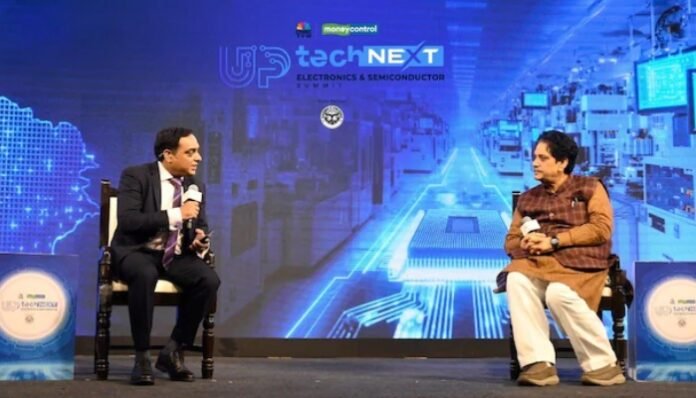
At the CNBC-TV18 & Moneycontrol UP Tech Next Electronics and Semiconductor Summit, the state government outlined how policy support, land readiness, and institutional coordination are coming together to attract chip manufacturing and allied electronics units.
Importantly, the state confirmed that dedicated land parcels have already been identified for semiconductor projects. Moreover, these efforts are being closely aligned with the Centre’s National Semiconductor Mission. This will ensure policy coherence and funding support. The first semiconductor facility in Uttar Pradesh is expected to become operational around 2027–28. This also reflects a long-term and serious commitment rather than a symbolic announcement.
Policy Push with Jobs and Self-Reliance at the Core
Speaking at the summit, IT and Electronics Minister Sunil Kumar Sharma said the state’s focus is on meaningful capacity building. While investor interest is rising, the government is also strengthening incentives and institutional support.
As a result, UP aims to create high-skilled employment and reduce India’s heavy dependence on imported chips.
Also Read: Uttar Pradesh Strengthens Strategic Partnership with Taiwan in Semiconductors and Data Centers
At the same time, the semiconductor push is designed to support a wider electronics manufacturing ecosystem. This includes digital services, emerging technologies, and advanced manufacturing clusters.
Consequently, the state hopes to become a key destination for companies looking to expand within India’s chip supply chain.
Semiconductors and the $1 Trillion Economy Goal
Adding an economic perspective, Chief Advisor to the CM Yogi, Awanish Kumar Awasthy, linked semiconductor manufacturing directly to Uttar Pradesh’s ambition of becoming a $1 trillion economy.
According to him, domestic chip demand is rising rapidly, and therefore self-reliance has become an economic necessity, not just a strategic choice.
Meanwhile, he pointed out that growing state revenues already show early signs of policy success. However, he also stressed the need for stronger inter-departmental coordination and deeper public–private partnerships to speed up on-ground execution.
From Policy Design to Delivery
From the national side, Dr Sushil Pal, Joint Secretary at MeitY, explained that Semicon 2.0 marks India’s transition from planning to delivery. Over the next few years, the focus will be on strengthening fabrication units, improving node capabilities, and building a complete semiconductor value chain.
Beyond industry, ministers highlighted how semiconductors can transform agriculture, cooperatives, and public services through digital innovation. Ultimately, the consensus at the summit was clear: with skills, policy backing, and manufacturing clusters, Uttar Pradesh is steadily positioning itself as a serious player in India’s semiconductor future and the broader Viksit Bharat 2047 vision.


