

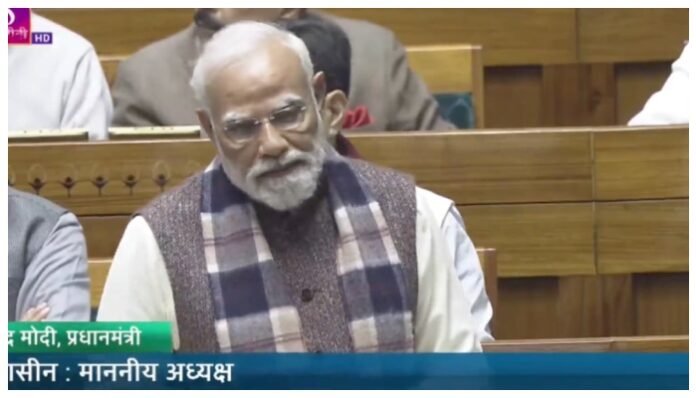
The discussion on Vande Mataram began in the Lok Sabha with an opening statement by Prime Minister Narendra Modi. While speaking, the Prime Minister said that Vande Mataram can continue to inspire future generations, provided that all citizens collectively uphold and use its values in the right way. He further explained that this powerful chant had once energized India’s freedom movement. Therefore, he noted, the nation today is witnessing a historic moment.
At the same time, PM Modi reminded the House that when Vande Mataram completed 150 years, India was still under British rule and bound by colonial chains. Similarly, when the song completed its 100 years, the country was suffering under the Emergency, during which the Constitution was undermined. Moreover, people who lived and died for the nation were imprisoned. Unfortunately, he said, this dark chapter became a painful part of India’s history. Hence, he expressed confidence that today’s discussion in Parliament would inspire national unity and shared progress.
PM Modi Says Vande Mataram Was Born in 1882 as a Strong Response
Explaining the origins of Vande Mataram, the Prime Minister said that Bankim Chandra Chattopadhyay began this literary journey in 1875. Importantly, the song was written at a time when the British were aggressive after the defeat of the 1857 uprising. As a result, Indians faced pressure and humiliation from colonial rulers. Meanwhile, the British anthem God Save the Queen was being pushed into every Indian household.
However, in response to this cultural domination, Bankim Chandra accepted the challenge. Consequently, he responded strongly and created Vande Mataram. Later, in 1882, when he wrote Anandamath, he included this powerful song in the novel.
Vande Mataram as a Sacred Call to Struggle
Addressing Members of Parliament, PM Modi said that this occasion represents a sacred moment to accept the spirit of struggle symbolized by Vande Mataram. Moreover, he highlighted that during the freedom struggle, every region of India—north, south, east, and west—advanced together with this chant. Therefore, he urged all representatives to once again move forward in unity, taking the nation along. Likewise, he said that Vande Mataram should inspire everyone to fulfill the dreams seen by freedom fighters.
Reference to Ancient Indian Thought and British Mindset
While recalling the colonial era, PM said the British habitually portrayed India as weak, lazy, and incapable. Sadly, he added, some Indians also began adopting the same language. Therefore, to awaken the nation and demonstrate India’s strength, Bankim Chandra used Vande Mataram effectively.
Additionally, PM Modi quoted ancient Indian texts, saying, “Mata Bhoomi Putro’ham Prithivyah”—which means the earth is my mother and I am her son. Similarly, he cited Lord Ram’s words, where he preferred his mother and homeland over the riches of Lanka, stating that the birthplace is greater than heaven.
PM Modi Accuses Congress of Continuing the Controversy
Moving forward, the Prime Minister criticized the Congress party, stating that even today it continues to create controversy over Vande Mataram. He said that after the October Kolkata decision, Congress chose compromise, which eventually led to the pain of Partition. Moreover, he accused Congress of promoting appeasement politics under the excuse of social harmony and aligning with the ideas of Muhammad Ali Jinnah.
Letter to Netaji and Allegations Against Nehru
Referring to historical records, PM Modi mentioned a letter written by Jawaharlal Nehru to Subhas Chandra Bose. According to the Prime Minister, Nehru expressed concern that Muslims might feel provoked by the background of the song. Furthermore, he accused Congress of dividing Vande Mataram during the October session due to political pressure, thereby surrendering to the Muslim League.
Events of October 1937 Highlighted
The Prime Minister said that Jinnah opposed the Vande Mataram slogan in Lucknow on October 15, 1937.Subsequently, Nehru failed to strongly condemn this opposition. Instead, five days later, on October 20, Nehru wrote to Netaji, agreeing with Jinnah’s concerns. He wrote that the background of Anandamath could offend Muslims and provoke unrest.
Soon after, Congress announced a meeting in Calcutta to discuss the usage of Vande Mataram. Consequently, PM Modi alleged, Congress diluted the song’s significance under the guise of compromise.
Congress Accused of Appeasement Politics
Continuing his criticism, PM Modi said that history proves Congress bowed before the Muslim League and followed appeasement politics. Therefore, this political approach eventually contributed to the Partition of India.
Final Reflection on Vande Mataram
Finally, the Prime Minister stated that no other song in world history carries emotions as powerful as Vande Mataram. Hence, he questioned why such a song was betrayed. While referencing Mahatma Gandhi, he said even Gandhi’s sentiments were dragged into unnecessary disputes. Consequently, he emphasized that on the 150th anniversary of Vande Mataram, it is important to discuss opposition politics and historical truths openly.
Concluding his speech, PM Modi said that Vande Mataram helped millions realize that India’s freedom struggle was not about land or power. Instead, it was a fight to break the chains of slavery and revive India’s ancient culture, rich heritage, and historical pride.


