

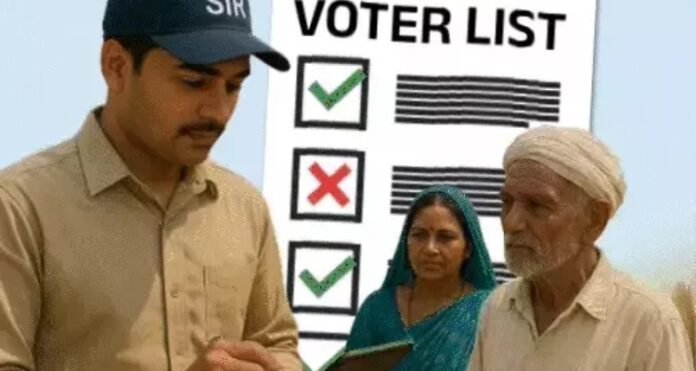
Uttar Pradesh has launched a Special Intensive Revision (SIR) drive of the electoral rolls from Tuesday(4 November). Booth Level Officers (BLOs) will start doorstep verification. The updated voter list after SIR will form the backbone of the 2027 Assembly elections. The exercise is a comprehensive audit involving the Chief Electoral Officer (CEO), BLOs, political parties, and voters.
Major political parties are fully mobilised. BJP and Samajwadi Party have deployed robust teams at every booth, while BSP has assigned responsibilities to booth presidents, sector heads, and Booth Level Agents (BLAs) with training provided. Congress and other parties are also strengthening booths as per their organisational strength.
Objections Window: 9 December – 8 January
- BLOs across 1.62 lakh+ booths begin door-to-door verification today.
- Based on their reports, Electoral Registration Officers (EROs) will publish the draft voter list on 9 December.
- Voters and parties may file claims and objections between 9 December and 8 January.
- EROs will dispose of them from 9 December to 31 January.
- Final SIR electoral roll will be released on 7 February.
20,000 New Polling Booths
Under the Election Commission’s new rule, a booth can have a maximum of 1,200 voters, improving accessibility and polling efficiency. As a result, booths in UP will rise from 1.62 lakh to over 1.82 lakh.
Also Read: Massive Voter Duplication Detected in UP, District Officials Unmoved — Can Panchayat Elections Stay on Schedule?
Why This SIR Exercise?
SIR is a time-bound, door-to-door verification programme to update and correct the voter rolls. It will include new voter registrations, deletion of names of deceased or migrated voters, correction of demographic details, and removal of errors.
How the Process Works
- Enumeration forms: Each family member gets a separate QR-coded form; forms are also online.
- Base roll: The 2003 roll used for SIR has been uploaded on the Election Commission website for public cross-check.
- Offline: BLOs will visit homes up to three times. Each member will get two forms — one to submit with documents, the other to keep signed by the BLO.
- Online: Voters away from home can fill out details on the National Voter Service Portal (NVSP). A receipt number will allow tracking.
BJP’s Booth-Strategy for SIR
The BJP is following its core philosophy: win the booth, win the election. The party is using SIR to consolidate voter lists booth-wise.
- A 5-6 member team formed with BLA-1 at every Assembly seat.
- A “booth pravasī” will operate at each booth along with BLA-2 and three workers.
- BJP has submitted details of BLA-1s to the CEO and districts have been informed.
- Booth teams have also been formed even in Muslim- and Yadav-dominated weak booths.
War Rooms at Region & District Level
The BJP has established SIR war rooms in Awadh, Kashi, West, Braj, Gorakhpur, and Kanpur regions with designated coordinators. They will review SIR progress daily, track booth-level work, and report absentee functionaries to the state headquarters.
District-level war rooms will also operate with teams of at least ten workers, monitoring daily enumeration progress and reporting filled forms booth-wise.
MPs & MLAs Given Charge
The party has assigned sitting MPs, 2024 Lok Sabha candidates, MLAs, and 2022 Assembly candidates the task of printing and verifying voter lists. They must set up Assembly-level war rooms, review SIR work every five days, maintain regular contact with booth and mandal workers, and address local issues during the campaign.


 drive of the electoral rolls from Tuesday(November 4).)